
An academic report presents research, analysis or findings in a clear, structured and evidence-based format. It usually explains a specific issue, method, set of results and final conclusions in a logical order. Academic reports often appear in university coursework, research projects and professional contexts that require formal written analysis.
This blog post explains what an academic report is and why universities use this formal writing format. It outlines the main structure of an academic report, including sections such as the introduction, methodology, findings, discussion and conclusion. In addition, it shows the target audience, offers a practical template and gives 12 clear steps for writing an academic report successfully. Finally, it includes a downloadable sample academic report.
Table of contents
Key takeaways
- An academic report presents research, analysis or findings in a formal structure
- Clear headings and organised sections improve readability
- Common sections include introduction, methodology, findings, discussion and conclusion
- Evidence and analysis matter more than personal opinion
- References support academic integrity and source checking
- Different audiences shape language and level of detail
Academic report
An academic report is a structured piece of formal writing that presents research, analysis or findings in a clear and evidence-based format. It explains a topic through logic, facts and organised sections. It aims to inform, evaluate or recommend action. Universities often require this format for coursework, research projects and case studies.
Key features of an academic report include
- clear structure with headings and subheadings
- formal academic language
- evidence from reliable sources
- analysis instead of opinion
- references and citations
- conclusion based on findings
Common sections in an academic report include
- introduction
- methodology
- findings
- discussion
- conclusion
- references
Structure of an academic report
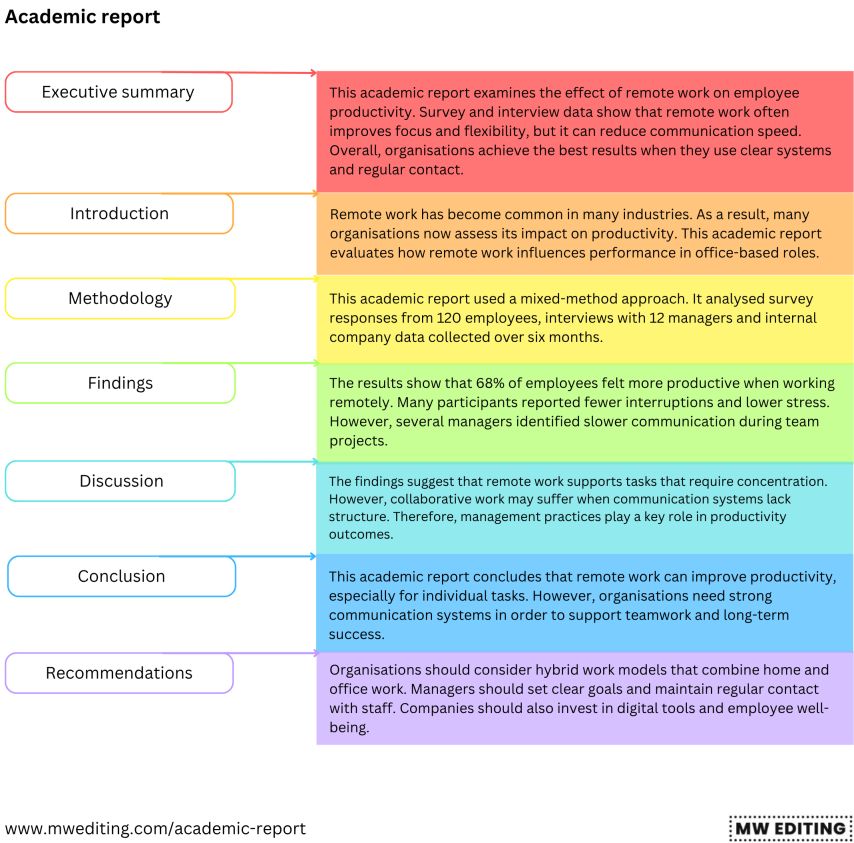
The structure of an academic report uses clear sections that guide the reader from the topic and method to the findings, analysis and final conclusions. Most academic report tasks follow a similar format. However, some subjects use different names or combine sections.
The structure of an academic report follows a clear order, and each section has a specific purpose in the overall argument.
Main sections are as follows:
- Executive summary
- Introduction
- Methodology
- Findings
- Discussion
- Conclusion
- Recommendations
- References
- Appendices
Executive summary
Some academic report assignments require an executive summary. This short section presents the aim, main findings, conclusion and key recommendations in brief form. It helps readers understand the main points quickly.
Introduction
The introduction sets up the topic and explains the purpose of the report. It gives context and shows what the report will examine.
A strong introduction often includes:
- background information
- the main aim
- research question or problem
- scope of the report
- key definitions
- brief overview of sections
This section should stay concise and focused.
Methodology
The methodology explains how the research or analysis took place. It shows that the academic report uses a logical and credible process.
Common content includes:
- research methods
- data sources
- sample or case selection
- time period
- analytical framework
- limitations
For example, a report may use surveys, interviews, case studies, experiments or secondary data.
Findings
The findings section presents the results in a clear and factual way. It shows what the research discovered.
This section may include:
- statistics
- patterns
- trends
- observations
- tables
- charts
- direct results from data
The focus stays on evidence rather than interpretation.
Discussion
The discussion analyses the findings and explains their meaning. This section forms the core argument of many academic report assignments.
It often includes:
- interpretation of results
- links to theory
- comparison with previous studies
- explanation of important patterns
- evaluation of significance
- response to the research question
Strong discussion uses evidence and clear reasoning.
Conclusion
The conclusion summarises the most important points from the report and gives the final answer or judgement.
A good conclusion:
- restates the aim
- highlights key findings
- gives the overall conclusion
- avoids new evidence
Recommendations
If the task asks for recommendations, this section suggests practical next steps based on the findings and discussion.
Effective recommendations are:
- specific
- realistic
- relevant
- evidence-based
References
The references section lists all sources cited in the academic report in the required style, such as Harvard, APA or MLA. Accurate referencing supports academic integrity.
Appendices
Appendices contain supporting material that would interrupt the main text. They add useful detail without reducing readability.
Examples include:
- questionnaires
- raw data
- calculations
- extended tables
- interview transcripts
Target audience
The target audience of an academic report usually includes lecturers, researchers, students and professional readers who need clear evidence-based information. The exact audience depends on the purpose of the report. However, most reports address readers who expect formal structure, logical analysis and reliable sources.
Common target audiences of an academic report include:
- Lecturers and assessors, who evaluate knowledge, analysis and academic skills
- Students, who use reports as examples or sources for study
- Researchers, who look for data, methods and new findings
- Professionals, who use subject knowledge for policy or practice
- Organisations, which need evidence for planning and decisions
- Academic institutions, which require reports for coursework and projects
Why audience matters in an academic report
The audience shapes key writing choices. For example, specialist readers may expect technical terms, while mixed audiences may need clearer explanations. In addition, all readers expect accurate references and a logical structure.
Academic report template
An academic report becomes easier to write with a question-based template because each answer builds a section of the final report.
Title
- What is the exact topic of the academic report?
- What key issue, case or problem does the title identify?
Executive summary
- What is the purpose of the report?
- What method did the research use?
- What are the main findings?
- What conclusion does the report reach?
- What key recommendations follow?
Introduction
- What topic does the report examine?
- Why does this topic matter?
- What background information helps explain the issue?
- What is the main aim of the report?
- What question or problem does the report address?
- What is the scope of the report?
- What sections follow in the report?
Methodology
- What research method did the report use?
- Why did this method suit the topic?
- What sources, data or materials were used?
- Who or what formed the sample or case study?
- What time period did the research cover?
- How was the data analysed?
- What limitations affected the research?
Findings
- What facts did the research reveal?
- What patterns or trends appeared?
- What important statistics support the results?
- What similarities or differences emerged?
- What direct evidence answers the research question?
Discussion
- What do the findings mean?
- How do the findings relate to the aim of the report?
- How do the results compare with previous research?
- What explains the main patterns?
- What are the most significant implications?
- What strengths and weaknesses appear in the evidence?
Conclusion
- What are the most important points from the report?
- What final answer does the report give?
- What overall judgement follows from the evidence?
Recommendations
- What actions should follow from the findings?
- Which recommendation has highest priority?
- What steps are realistic and practical?
- How can organisations or readers apply these ideas?
References
- Which sources did the report cite?
- Which referencing style does the task require?
Appendices
- What extra material supports the report?
- Which tables, surveys or raw data should appear outside the main text?
Sample academic report
Download a sample academic report here.
Write an academic report in 12 steps
Writing an academic report becomes simpler with a clear step-by-step process that moves from planning to final editing.
- Understand the task: Read the brief carefully. Identify the topic, word count, deadline, required sections and referencing style. Note all assessment criteria.
- Define the aim: State the main purpose of the report. Identify the question, problem or case that the report will address.
- Research the topic: Gather reliable academic sources such as books, journal articles and trusted reports. Record full reference details from the start.
- Plan the structure: Create headings for each section of the academic report, such as introduction, methodology, findings, discussion and conclusion.
- Write the introduction: Explain the topic, give brief background information and state the aim and scope of the report.
- Write the methodology: Explain how the research took place. Describe methods, sources, sample and limitations.
- Write the findings: Present the key results clearly. Use evidence, data and examples that relate to the aim.
- Write the discussion: Analyse the findings. Explain their meaning, compare sources and link points to the research question.
- Write the conclusion: Summarise the main points and give the final answer based on the evidence.
- Write recommendations: State practical actions if the task requires them. Base each recommendation on the findings.
- Add references and appendices: List all cited sources in the correct style. Add supporting material in appendices if needed.
- Edit and proofread: Check structure, grammar, clarity, spelling and referencing accuracy. Ensure the academic report meets the brief. If you would like a fast, straightforward way to refine your report, flow and clarity in your writing, learn more about the express editing service for shorter texts.
How professional editing services can prepare an academic report for publication
Professional editing services can prepare an academic report for publication by improving the qualities that publishers, assessors and professional readers value most, such as clarity, accuracy, structure, consistency and credibility.
If your academic report needs a fast and straightforward review for clarity, consistency and presentation, learn more about the express editing service.
Clearer structure and stronger argument
A publishable academic report needs a logical flow from introduction to conclusion. If sections feel uneven, repetitive or unclear, a developmental editor can strengthen the structure and sharpen the main argument.
This support may include:
- clearer research aims
- better section order
- stronger transitions between ideas
- removal of repetition
- tighter conclusions linked to evidence
Sharper style and better readability
Strong ideas can lose impact when sentences feel dense, awkward or vague. A line editor improves expression at sentence and paragraph level while protecting the author’s meaning.
This often includes:
- clearer sentence structure
- stronger word choice
- smoother paragraph flow
- reduced wordiness
- more natural academic tone
Accuracy and professional presentation
Publication standards require correct grammar, punctuation, spelling and formatting. A copyeditor checks the technical details that affect professionalism and credibility.
A copyeditor may improve:
- grammar and syntax
- punctuation
- spelling
- terminology use
- heading hierarchy
- table and figure labels
- citation style consistency
- house style compliance
Consistency across the full document
Many academic reports contain small inconsistencies that weaken trust. For example, terms may change, headings may vary or references may not match in-text citations. Copyediting helps create a consistent final text.
Error-free final submission
Even strong reports can contain last-minute mistakes. Proofreading provides the final quality check before submission, printing or publication.
Proofreading usually focuses on:
- typographical errors
- punctuation slips
- spacing issues
- numbering errors
- layout inconsistencies
- minor reference mistakes
Better chances of acceptance and stronger reader response
Editors, lecturers and publishers often make quick judgements based on presentation as well as content. A clear, accurate and well-structured academic report creates a stronger first impression and allows the research to stand out.
In short, professional support does not replace research quality, but it helps present that quality effectively.
Resources
- A Manual for Writers of Research Papers, Theses, and Dissertations by Kate L. Turabian: A standard academic reference guide that explains citation practices, research organisation and formal academic presentation.
- Academic Writing for Graduate Students by John M. Swales and Christine B. Feak: A widely used guide that helps students understand academic genres, including reports, research writing and disciplinary conventions.
- Stylish Academic Writing by Helen Sword: A readable guide that shows how to improve clarity, style and engagement in academic prose without losing scholarly credibility.
- The Craft of Research by Wayne C. Booth, Gregory G. Colomb, Joseph M. Williams, Joseph Bizup and William T. Fitzgerald: This book explains how to develop research questions, organise evidence and build logical academic arguments.
- Writing for Academic Success by Gail Craswell: A practical introduction to academic writing that explains structure, argumentation and formal style in clear language suitable for university students.
Conclusion
An academic report succeeds through clear structure, strong evidence and logical analysis. Students who understand each section and follow a clear writing process can produce stronger academic work. With the right planning, an academic report becomes far more manageable.
Contact me if you are an academic author looking for editing or indexing services. I am an experienced editor offering a free sample edit and an early bird discount.
If you would like professional help refining your text for clarity, consistency and presentation, you can also use my short-text editing service for a fast, straightforward edit with transparent pricing and a 5-day turnaround.