
A feasibility study evaluates a proposed project to determine if it is practical, viable and worth pursuing. It examines key areas such as market demand, technical requirements, operational capacity, financial implications, legal issues and potential risks. The document ends with a clear recommendation based on the evidence.
This blog post explains how to write a feasibility study in a clear and structured way. It covers the definition, purpose, target readers, core components and typical length of a feasibility study. It also includes a downloadable sample, a step-by-step writing process, a question-based template, practical writing tips and an explanation of how professional support can improve the final document.
Table of contents
- Key takeaways
- What is a feasibility study?
- Who are the target readers of a feasibility study?
- Components of a feasibility study
- How long is a feasibility study?
- How to write a feasibility study?
- Feasibility study template
- Sample feasibility study
- Tips for writing a feasibility study
- How professional editing services improve a feasibility study
- Resources
- Conclusion
Key takeaways
- A feasibility study assesses if a project is practical, viable and worth pursuing
- A feasibility study can apply to business, academic, public-sector and non-profit projects
- A feasibility study usually includes market, technical, operational, financial, legal and risk analysis
- A feasibility study should address the needs of decision-makers, funders and other stakeholders
- A feasibility study often ranges from 1,000–5,000+ words depending on purpose and complexity
- Clear language, consistent terminology and direct evidence improve a feasibility study
What is a feasibility study?
A feasibility study is a structured document that evaluates the practicality, viability and potential success of a proposed project.
In other words, a feasibility study assesses key factors that determine if a project can proceed. It examines technical, financial, operational and legal aspects in a clear and organised format. As a result, it supports informed decision-making and reduces risk.
Examples
A feasibility study may assess projects such as these:
- opening a café in a new location
- launching an online editing or consultancy service
- building a housing development
- introducing a new software system in an organisation
- starting a university degree programme
- expanding a charity service into a new region
Scope
A feasibility study typically includes:
- Technical feasibility: assessment of resources, tools and expertise
- Financial feasibility: analysis of costs, funding and expected returns
- Operational feasibility: evaluation of processes and implementation
- Legal feasibility: review of regulatory and compliance issues
- Market feasibility: analysis of demand, competition and target audience
Purpose
A feasibility study aims to:
- Identify potential risks and constraints
- Evaluate project benefits and limitations
- Support planning and resource allocation
- Provide evidence for approval or rejection
In summary, a feasibility study presents a clear, evidence-based evaluation of whether a project is viable and worth pursuing.
Who are the target readers of a feasibility study?
The target readers of a feasibility study are the people who decide, fund, review or carry out the proposed project. Each group of target readers looks for different information, so the document needs clear structure and direct language.
- Decision-makers: senior managers, directors or committee members who approve or reject the project
- Investors and funders: people or organisations that assess financial risk, return and value
- Project managers: staff who plan timelines, resources and delivery
- Technical specialists: experts who review methods, systems, staffing or infrastructure
- Clients or stakeholders: parties with an interest in the project outcome, cost or impact
- Regulators or compliance reviewers: bodies that check legal, safety or policy requirements
The target readers shape the content and tone of a feasibility study. For example, decision-makers often want a clear recommendation, while technical specialists need enough detail to assess practical issues. As a result, a strong feasibility study balances summary-level findings with supporting evidence.
Components of a feasibility study
A feasibility study consists of clearly structured sections that assess the viability of a proposed project from practical, financial and strategic perspectives. It usually includes the following sections.
- Executive summary: a brief overview of the project, main findings and final recommendation
- Project description: an explanation of the idea, purpose, scope and objectives
- Market analysis: a review of demand, target audience, competitors and market conditions
- Technical feasibility: an assessment of equipment, technology, systems, materials and expertise
- Operational feasibility: an explanation of how the project would work in practice
- Financial feasibility: an analysis of costs, funding, projected revenue and expected return
- Legal and regulatory review: a discussion of laws, permits, standards and compliance issues
- Risk assessment: identification of potential problems and ways to reduce them
- Timeline or implementation plan: a clear outline of stages, deadlines and key actions
- Conclusion and recommendation: a final judgement on the project’s viability
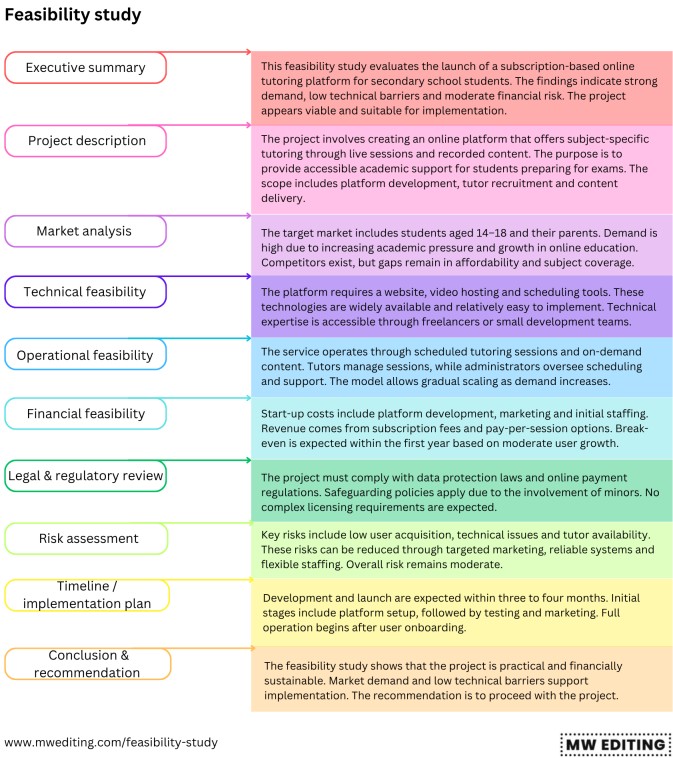
Each section has a specific role. For example, the market analysis shows demand, while the financial feasibility shows cost and value. As a result, the full feasibility study gives decision-makers a clear basis for action.
How long is a feasibility study?
A feasibility study has no fixed length because the final word count depends on the project’s size, complexity and purpose.
Most feasibility study documents fall into 1 of 3 broad ranges.
- Short feasibility study: 1,000–2,500 words for small internal projects or early-stage proposals
- Standard feasibility study: 2,500–5,000 words for most business, academic or organisational purposes
- Detailed feasibility study: 5,000 words or more for complex projects with technical, financial or regulatory demands
What affects the length of a feasibility study
Several factors shape the length of a feasibility study:
- Project scope: larger projects need more explanation and evidence
- Audience: investors, boards and regulators often expect more detail
- Industry requirements: some sectors require technical appendices or formal risk analysis
- Data volume: market research, budgets and legal review increase length
- Document purpose: an internal screening report is usually shorter than a funding document
In summary, a feasibility study usually ranges from about 1,000 words for a simple case to 5,000 words or more for a complex project.
How to write a feasibility study?
A feasibility study can be written effectively by following a clear step-by-step process that moves from defining the project to presenting a justified recommendation. Follow these practical steps to write a feasibility study from scratch:
- Start with a project definition: Write 1–2 paragraphs that explain:
- what the project is
- what problem it solves
- what success looks like
- Draft the executive summary last: After completing the full feasibility study, write a 150–300 word summary that includes:
- the project idea
- key findings
- the final recommendation
- Describe the project in detail: Expand the idea into a short section:
- scope: what is included and excluded
- objectives: clear, measurable aims
- context: background or rationale
- Analyse the market or need: Explain why the project is necessary:
- target audience or users
- demand or problem size
- competitors or alternatives
- Assess technical feasibility: State how the project will work in practice:
- tools, systems or technology required
- skills or expertise needed
- availability of resources
- Assess operational feasibility: Explain how the project will run day to day:
- workflow or process
- staffing or roles
- location or logistics
- Analyse financial feasibility: Present realistic figures, including:
- estimated costs
- funding sources
- expected benefits or return
- Identify risks and constraints: List key risks and how to manage them; for example:
- financial, technical or legal risks
- mitigation strategies
- Create a timeline: Outline main stages with approximate timeframes
- Write the conclusion and recommendation: State clearly:
- if the project is viable
- why the evidence supports this decision
Feasibility study template
A feasibility study template based on targeted questions helps structure the document and ensures that each section provides clear, decision-relevant information. Use the following questions to build each section of a feasibility study.
Executive summary
- What is the project in one or two sentences?
- What are the main findings of the feasibility study?
- What is the final recommendation and why?
Project description
- What is the project idea?
- What problem does it address?
- What are the main objectives?
- What is included and excluded from the scope?
Market analysis
- Who is the target audience or user group?
- What need or demand does the project address?
- What alternatives or competitors exist?
- What makes this project different or necessary?
Technical feasibility
- What technology, tools or systems are required?
- Are these resources available or accessible?
- What expertise or skills are needed?
- What technical challenges may arise?
Operational feasibility
- How will the project operate on a day-to-day basis?
- What processes or workflows are required?
- What roles or staff are needed?
- What logistical issues must be addressed?
Financial feasibility
- What are the estimated start-up and ongoing costs?
- What funding sources are available?
- What financial benefits or returns are expected?
- When will the project break even?
Legal and regulatory review
- What laws or regulations apply to the project?
- Are permits, licences or approvals required?
- What compliance risks exist?
Risk assessment
- What are the main risks (financial, technical, operational)?
- How likely is each risk?
- What impact would each risk have?
- How can these risks be reduced or managed?
Timeline or implementation plan
- What are the main project stages?
- What is the estimated timeframe for each stage?
- What are the key milestones?
Conclusion and recommendation
- Is the project feasible based on the evidence?
- What are the strongest supporting factors?
- What are the main limitations or concerns?
- What is the final recommendation?
Sample feasibility study
Download the sample feasibility study here.
Tips for writing a feasibility study
- Use clear and direct language:
- Use short, declarative sentences
- Prefer specific terms over vague wording
- State findings directly, e.g. ‘The project is financially viable’
- Maintain consistent terminology to improve readability:
- Use the same terms for key concepts throughout
- Keep figures, labels and categories consistent across sections
- Prioritise evidence over opinion:
- Support statements with figures, comparisons or examples
- Avoid unsupported claims such as ‘strong demand exists’ without explanation
- Structure paragraphs around one point:
- Start with a clear topic sentence
- Follow with supporting detail
- End with a short implication or conclusion
- Use signposting for clarity to help readers follow the argument:
- Use phrases such as ‘First’, ‘Next’, ‘As a result’
- Link sections logically; for example: market demand section leads into financial projections
- Write for decision-makers:
- Highlight key findings early in each section
- Avoid unnecessary background detail
- Keep explanations relevant to viability
- Keep tone formal and neutral:
- Avoid promotional or persuasive language
- Use measured terms such as ‘indicates’, ‘suggests’, ‘shows’
- Present numbers clearly:
- Keep units and formats consistent
- Explain what the numbers mean for the project
How professional editing services improve a feasibility study
Clear structure and stronger logic
A feasibility study needs a logical structure so that readers can move easily from the project idea to the evidence and the final recommendation. In practice, early drafts often contain sections that feel out of sequence or conclusions that do not fully reflect the analysis. A developmental editor can identify those structural problems and suggest a clearer order for the material. As a result, the text becomes easier to follow and better suited to formal submission.
Better clarity and readability
A feasibility study often brings together technical detail, financial information and practical planning. That mix can make the writing dense or difficult to follow. A line editor can improve sentence flow, sharpen transitions and reduce repetition. As a result, the feasibility study becomes clearer for both specialist and non-specialist readers.
Stronger consistency and precision
A feasibility study depends on consistent terminology, accurate figures and uniform presentation across sections. However, inconsistency often appears during revision, especially when a document includes tables, projections and repeated key terms. A copyeditor can correct grammar, punctuation and usage while also checking consistency in wording, formatting and style. Therefore, the text reads as a more precise and professional document.
More accurate and polished presentation
A feasibility study may go through several rounds of drafting, review and revision before submission. That process can leave behind small but visible errors such as typos, spacing problems and formatting inconsistencies. A proofreader can catch those final issues once the text is otherwise complete. This final stage helps ensure that the feasibility study looks polished and submission ready.
Clearer tone for the intended audience
A feasibility study needs to match the expectations of its intended readers. For instance, a document prepared for investors may need concise emphasis on financial risk, while one prepared for an academic committee may need more explanation and context. Drafts do not always strike that balance successfully. A developmental editor or line editor can help adjust tone, emphasis and level of detail to suit the audience more effectively.
Greater credibility at submission stage
A feasibility study needs to appear reliable as well as informative. Weak structure, awkward phrasing and surface errors can reduce confidence in the document, even when the analysis itself is sound. Developmental editing, line editing, copyediting and proofreading each strengthen a different aspect of the text. Together, they help present the text as a credible and well-prepared document.
If your feasibility study needs a clear, professional final review before submission, try the express editing service.
Resources
- Manual for the Preparation of Industrial Feasibility Studies by United Nations Industrial Development Organization: This is the most widely cited reference in feasibility analysis. It focuses on project appraisal, investment decision-making and economic evaluation. It suits advanced academic and policy contexts.
- Project Appraisal and Planning for Developing Countries by Warren C. Baum and Stokes M. Tolbert: This book explains feasibility from a development and planning perspective. It emphasises cost–benefit analysis, risk and long-term project impact.
- Cost-Benefit Analysis: Concepts and Practice by Anthony E. Boardman et al.: This is not a feasibility study guide as such, but it provides the analytical backbone for financial and economic feasibility.
Conclusion
In summary, a feasibility study succeeds when it combines clear structure, relevant evidence and direct language. Each section should answer a specific question about viability and support a final recommendation. Careful writing and professional review can improve clarity, consistency and credibility at submission stage.
Contact me if you are an academic author looking for editing or indexing services. I am an experienced editor offering a free sample edit and an early bird discount.
If you would like professional help refining your feasibility study for clarity, consistency and presentation, you can also use my short-text editing service for a fast, straightforward edit with transparent pricing and a 5-day turnaround.