
Academic books are scholarly publications that present original research, critical analysis or theoretical contributions for an academic audience. They play an important role in advancing knowledge within and across disciplines by allowing authors to examine complex topics in greater depth than is typically possible in journal articles. Academic books may take the form of monographs, edited collections, textbooks or reference works and are commonly used in research, teaching and professional practice.
This blog post discusses what academic books are and how they differ from other forms of scholarly publishing. It explores where academic book ideas come from, including doctoral research, published studies, gaps in the literature and interdisciplinary collaborations. The guide also explains how to assess whether a topic has the scope and originality required for a book, how to develop a proposal for an academic publisher and what to expect during the publication process.
In addition, the guide examines the role of professional editorial support in improving the clarity, structure and quality of a manuscript. Readers can also access a downloadable resource, the Academic book idea workbook, which provides practical exercises and planning tools to help researchers evaluate, refine and develop potential book projects before approaching publishers.
Table of contents
Key takeaways
- A strong proposal explains the book’s argument, contribution, audience and relationship to competing titles.
- Academic books allow researchers to explore a topic in greater depth than journal articles.
- Most academic books develop from existing research rather than entirely new projects.
- Common sources of book ideas include PhD theses, published research, literature gaps and interdisciplinary collaborations.
- Not every research topic is suitable for a book; successful projects require sufficient scope, evidence and a clear argument.
- Academic publishers typically request a proposal before reviewing a complete manuscript.
What is an academic book?
An academic book is a scholarly publication that presents original research, expert analysis or a new interpretation of a subject. Academic books contribute to knowledge within a specific field and help advance scholarly discussion.
Unlike journal articles, academic books allow authors to explore a topic in greater depth. They provide space for detailed discussion of theories, methods, evidence and conclusions.
Academic books are often referred to as monographs, although edited collections and textbooks also form part of academic publishing.
What is an academic book about?
Academic books focus on specialised research topics, questions or areas of study. Authors typically draw on:
- Original research
- Long-term scholarly expertise
- Critical analysis of existing literature
- New theoretical approaches
- New methodological approaches
For example, an academic book may examine a historical period, analyse a literary genre, investigate a social issue or develop a new research framework.
How is an academic book different from a journal article?
Although both contribute to scholarly knowledge, they serve different purposes.
Academic books typically:
- Explore a broader topic
- Develop a sustained argument across multiple chapters
- Engage extensively with existing scholarship
- Present larger bodies of evidence
- Reach book-length word counts
Journal articles typically:
- Address a narrower research question
- Focus on a specific argument or finding
- Present a limited selection of evidence
- Have strict word limits
As a result, many researchers use journal articles and academic books for different stages of a research project.
What is the structure of an academic book?
The structure varies by discipline and publisher, but most academic books include:
- Introduction
- Literature review or discussion of existing scholarship
- Several thematic or chronological chapters
- Conclusion
- References or bibliography
- Index
The introduction outlines the research problem, objectives and significance. The main chapters develop the argument, while the conclusion summarises the book’s contribution.
Who reads academic books?
Academic books primarily target:
- Researchers
- University lecturers
- Postgraduate students
- Early career researchers
- Advanced undergraduate students
Some academic books also reach policymakers, professionals and general readers with a strong interest in the subject.
Why write an academic book?
Writing an academic book requires a significant investment of time and effort. However, for many researchers, it provides opportunities that journal articles cannot. For example, academic books allow authors to explore complex topics in greater depth, develop sustained arguments and reach readers across a field or discipline.
Common reasons for writing an academic book include a wish to share the original research, develop larger argument, and establish expertise, among others.
Share original research
An academic book allows researchers to present original findings in greater detail than a journal article. The additional space makes it possible to discuss evidence, methodology and scholarly debates more extensively. As a result, books often become important reference works within a field.
Develop a larger argument
Some research questions require more space than a journal article can provide. An academic book allows authors to connect multiple case studies, sources or themes into a single coherent argument. This can help researchers demonstrate the broader significance of their work.
Establish expertise in a field
Publishing an academic book can help researchers build a reputation within their area of specialisation. A well-received book demonstrates subject expertise and can increase visibility among scholars working on related topics.
Build on a PhD thesis or research project
Many academic books develop from doctoral research, postdoctoral projects or long-term research programmes. Rather than presenting a single study, a book allows researchers to refine, expand and contextualise their findings for a wider scholarly audience.
Reach new audiences
Academic books often reach readers beyond the author’s immediate area of research. Depending on the topic, potential readers may include scholars from related disciplines, postgraduate students, policymakers or professionals working in the field.
Contribute to scholarly debates
Academic books play an important role in advancing knowledge. Researchers use books to challenge existing interpretations, introduce new evidence, develop theoretical frameworks and open new areas of inquiry. As a result, books remain an important form of scholarly communication in many disciplines.
Where do academic book ideas come from?
Many researchers assume they need a completely new idea before they can write an academic book. In reality, most academic books develop from existing research, ongoing projects or unanswered questions within a field.
The challenge is not finding a topic. It is identifying a subject that can support a book-length argument and make a meaningful contribution to existing scholarship.
Turning a PhD thesis into a book
A PhD thesis remains one of the most common starting points for an academic book.
However, a thesis and a book serve different purposes. A thesis demonstrates the author’s ability to conduct original research, while a book aims to engage readers and contribute to scholarly debates.
As a result, researchers often need to:
- Refine the central argument
- Reduce methodological detail
- Reorganise chapters
- Clarify the target audience
- Emphasise the book’s contribution to the field
Many successful academic monographs begin as doctoral research but undergo substantial revision before publication.
Building on published research
Academic books often emerge from several years of research rather than a single project.
Potential starting points include:
- Journal articles
- Conference papers
- Research reports
- Postdoctoral projects
- Long-term research interests
In some cases, a series of related publications reveals a broader theme or question that can support a book-length study.
Identifying gaps in the literature
One of the most effective ways to generate an academic book idea is to examine the existing literature.
Useful opportunities may include:
- Understudied topics
- Conflicting interpretations
- Neglected sources or datasets
- New theoretical perspectives
- Questions that previous studies have not fully addressed
A strong academic book does not simply summarise existing research. It advances the conversation by offering a new argument, perspective or body of evidence.
Responding to emerging developments in your field
Changes within a discipline can create opportunities for new book projects.
Examples include:
- New archival discoveries
- Technological developments
- Social or political change
- New research methods
- Growing interest in a particular topic
Researchers who engage with emerging developments can often identify questions that existing scholarship has not yet fully explored.
Bringing together several related projects
Not every academic book begins as a single large research project.
Sometimes a book develops from several smaller studies that address a common theme or problem. Bringing these projects together can help researchers identify broader patterns, connections and arguments.
Questions to consider include:
- Do these projects address a similar issue?
- Do they share a theoretical framework?
- Can they contribute to a larger argument?
- Would readers benefit from seeing them discussed together?
Collaborating across disciplines
Some of the most innovative academic books emerge at the intersection of different disciplines.
For example, researchers may combine perspectives from:
- History and literary studies
- Sociology and public health
- Geography and environmental science
- Digital humanities and computer science
Interdisciplinary research can reveal questions, methods and perspectives that remain overlooked within a single field.
Is your idea suitable for a book?
Not every research topic needs to become an academic book. Some ideas work better as journal articles, book chapters or research reports.
Before developing a proposal, ask the following questions:
- Can the topic support multiple chapters?
- Is there a clear central argument?
- Does the project contribute something new?
- Is there enough evidence to sustain a book-length discussion?
- Does the topic address an identifiable audience?
- Can you explain the book’s contribution in a few sentences?
If the answer to most of these questions is yes, the project may have the potential to become an academic book.
From idea to proposal
Once you have identified a promising book idea, the next step is to determine whether it can become a viable publishing project.
Most academic publishers do not expect authors to submit a complete manuscript initially. Instead, they ask for a book proposal that explains the project’s argument, contribution and audience.
Although requirements vary by publisher, the process typically follows several stages.
Refine the central argument
A strong academic book needs more than an interesting topic.
Before preparing a proposal, you should be able to explain:
- The main research question
- The central argument
- The book’s contribution to existing scholarship
- Why the topic matters
Many publishers and reviewers will evaluate the proposal primarily on the strength of the argument rather than the subject itself.
Identify the target audience
Publishers want to know who will read the book.
Potential audiences may include:
- Researchers in a specific field
- Interdisciplinary scholars
- Postgraduate students
- Advanced undergraduate students
- Professionals and practitioners
A clearly defined audience helps publishers assess the book’s potential impact and market.
Develop a provisional chapter outline
A chapter outline demonstrates how the argument will develop throughout the book.
Most academic book proposals include:
- An introduction
- Several thematic or chronological chapters
- A conclusion
Each chapter should contribute directly to the central argument rather than function as a standalone piece of research.
Research competing titles
Publishers will want to know how your book differs from existing publications.
Review recent books in your field and consider:
- What topics they cover
- Their intended audience
- Their strengths and limitations
- How your book makes a different contribution
This exercise can also help refine your argument and position your project more effectively.
Identify suitable publishers
Different publishers specialise in different disciplines and types of books.
When evaluating potential publishers, consider:
- Their subject areas
- Similar titles in their catalogue
- The audiences they serve
- Whether they publish monographs, edited collections or textbooks
A strong fit between the project and the publisher can improve the likelihood of a successful proposal.
Prepare the book proposal
Most academic book proposals include:
- A project overview
- A description of the target audience
- The book’s contribution to the field
- A discussion of competing titles
- A chapter-by-chapter summary
- Information about the author
Some publishers may also request sample chapters or a timetable for completing the manuscript.
Revise in response to feedback
Many publishers send proposals to subject specialists for peer review.
Reviewers typically assess:
- Scholarly contribution
- Originality
- Structure and organisation
- Methodology
- Audience and market potential
Download the Academic book idea workbook
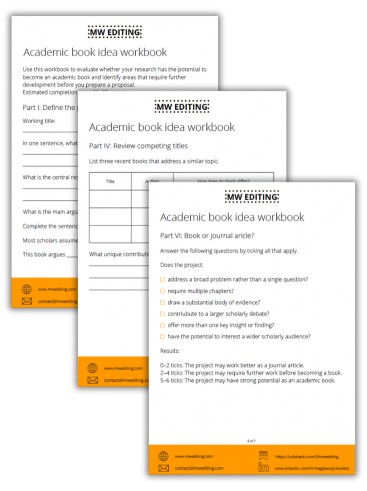
If you are still developing your project, download our free Academic book idea workbook.
The workbook includes practical exercises to help you:
- Assess the strength of your idea
- Identify gaps in the literature
- Define your target audience
- Evaluate competing titles
- Plan potential chapters
- Determine whether your project is suitable for a book
- Assess your readiness to prepare a proposal
How professional editorial support can strengthen an academic book?
Professional editorial support can improve clarity, structure, consistency, accuracy and readability throughout the publication process. Developmental editors, line editors, copyeditors and proofreaders each contribute to different aspects of manuscript preparation and can help researchers present their work in the strongest possible form.
Strengthening the central argument
A strong academic book requires a clear and consistent argument across all chapters.
A developmental editor can help identify gaps in reasoning, clarify the book’s contribution to the review of related literature and ensure that individual chapters support the overall thesis. This type of review often proves particularly valuable when a book develops from a PhD thesis or a collection of articles.
Improving structure and organisation
Even strong research can lose impact if readers struggle to follow the argument. A developmental editor can assess chapter order, transitions between chapters and the overall progression of ideas. As a result, the manuscript often becomes easier to navigate and more persuasive.
Enhancing clarity and readability
Academic books frequently address complex concepts, theories and evidence. However, complexity should not result in unnecessary difficulty. A line editor can improve sentence structure, paragraph flow and readability while preserving the author’s scholarly voice. Consequently, readers can focus on the argument rather than struggle with the prose.
Ensuring consistency
Long manuscripts often contain inconsistencies in terminology, spelling, capitalisation, transliteration and citation style. A copyeditor can identify and correct these issues throughout the manuscript. Consistency helps readers engage with the content and supports a professional presentation.
Improving accuracy and attention to detail
Small errors can undermine confidence in an otherwise strong manuscript. A copyeditor can check references, citations, cross-references, tables, figures and other technical elements. This process reduces the likelihood of problems during production.
Preparing the manuscript for production
Before publication, the manuscript should meet the publisher’s style and formatting requirements. A copyeditor can help align the text with relevant style guides and publisher specifications. Therefore, the production process often proceeds more smoothly.
Eliminating typographical errors
Even after extensive revision, most manuscripts contain minor mistakes. A proofreader conducts a final review before publication and identifies typographical errors, formatting issues and inconsistencies that remain in the text. This final quality-control stage helps ensure a polished publication.
Resources
- From Dissertation to Book by William Germano: A classic guide for researchers who want to transform a PhD thesis into a scholarly monograph. Explains how academic books differ from dissertations and how publishers evaluate book projects.
- Getting It Published: A Guide for Scholars and Anyone Else Serious about Serious Books by William Germano: An accessible introduction to academic publishing that covers proposals, peer review, contracts and publisher expectations.
- The Book Proposal Book: A Guide for Scholarly Authors by Laura Portwood-Stacer: A practical guide to developing a strong book proposal, identifying a target audience and presenting a compelling scholarly contribution.
- How to Write a Lot: A Practical Guide to Productive Academic Writing by Paul J. Silvia: Focuses on sustainable writing habits and productivity strategies that can help researchers complete long-form projects such as academic books.
- The Chicago Guide to Writing about Multivariate Analysis by Jane E. Miller: Demonstrates how to communicate complex research clearly and effectively. Particularly useful for social science researchers.
- Stylish Academic Writing by Helen Sword: Shows how to write academic prose that remains rigorous while improving clarity, readability and engagement.
- The Elements of Academic Style by Eric Hayot: Examines argumentation, structure and scholarly voice in humanities research and academic books.
- The Professor Is In: The Essential Guide to Turning a PhD into a Job by Karen Kelsky: Includes practical advice on academic publishing, book development and building a research profile in the early stages of an academic career.
Conclusion
Academic books remain an important way of sharing research, developing complex arguments and contributing to scholarly debates. Whether a project grows from a PhD thesis, published research or a new question within a field, a successful book requires a clear argument, a defined audience and a meaningful contribution to existing scholarship. By evaluating your idea carefully and developing a strong proposal, you can increase the likelihood of turning your research into a viable academic book project. Remember to download our free Academic book idea workbook.
Contact me if you are an academic author looking for editing or indexing services. I am an experienced editor offering a free sample edit and an early bird discount.