
An academic book review evaluates a scholarly book’s argument, evidence and contribution to its field. It combines a brief summary with critical analysis and helps readers assess the book’s relevance to their research. A book review format example provides a framework for this assessment, while publication guidelines determine specific requirements.
This blog post explains how to structure and prepare an academic book review for publication. It covers the purpose of reviews, publication venues, essential elements and common pitfalls, then provides a fictional review and a question-based format example. It also introduces practical resources and explains how line editing, copyediting and proofreading can improve clarity, consistency and presentation.
Table of contents
- Key takeaways
- Academic book review
- Function of academic book reviews
- Publication of academic book reviews
- Structure of academic book reviews
- Example of an academic book review
- What to avoid when writing an academic book review
- What to always include in an academic book review
- Format example of an academic book review
- Resources
- Preparing an academic book review for publication
- Conclusion
Key takeaways
- An academic book review evaluates the book’s argument, evidence and scholarly contribution.
- Its structure typically includes bibliographic details, an introduction, a brief summary, critical evaluation and a conclusion.
- Effective reviews support judgements with specific examples and evaluate the book against its stated aims.
- Excessive summary, personal criticism and unsupported claims weaken a review.
- A book review format example offers a structural guide, while publication guidelines set specific requirements.
Academic book review
An academic book review is a critical assessment of a scholarly book’s argument, evidence and contribution to its field.
It briefly summarises the book’s content, then evaluates its strengths and limitations in relation to existing research. In addition, it considers the author’s methods, the book’s structure and its relevance to a particular academic audience.
A typical book review format example includes these elements:
- Introduction to the book, author and subject
- Brief summary of the central argument and scope
- Critical analysis of the evidence, methods and contribution
- Overall assessment of the book’s value to the field
Function of academic book reviews
An academic book review evaluates a scholarly book’s contribution to its field and helps readers assess its relevance to their research.
Its main purposes are to:
- Explain the book’s central argument and scope
- Assess the quality of its evidence and methods
- Identify strengths, limitations and gaps
- Compare its contribution with existing scholarship
- Inform academic debate and guide reading choices
Therefore, a useful book review format example includes both a brief summary and a critical assessment of the book.
Publication of academic book reviews
Academic book reviews appear in scholarly journals, specialist review publications and academic platforms.
Common publication venues include:
- Scholarly journals: publish reviews of books relevant to their discipline, often in a dedicated section
- Specialist review journals: focus primarily on critical assessments of new scholarly books
- Academic websites and blogs: offer reviews for researchers, students and wider audiences
- Higher education publications: discuss scholarly books across disciplines for a broader readership
Structure of academic book reviews
An academic book review typically includes the book’s bibliographic details, an introduction, a brief summary, a critical evaluation and a concluding assessment.
The following book review format example outlines a common structure:
- Bibliographic details: List the author, title, publisher, publication year and any additional details the publication requires (for example, ISBN, number of pages or retail price).
- Introduction: Introduce the subject, the book’s purpose and its place within the field. State the review’s overall assessment.
- Summary: Briefly explain the central argument, scope and approach. Prioritise key themes over a chapter-by-chapter account.
- Critical evaluation: Assess the argument, evidence, methods and organisation. Support judgements with specific examples and consider how the book contributes to existing scholarship.
- Conclusion: Summarise the assessment and identify the book’s relevance to particular readers or research areas.
However, many publications set their own requirements for length, references and layout, so their submission guidelines take precedence.
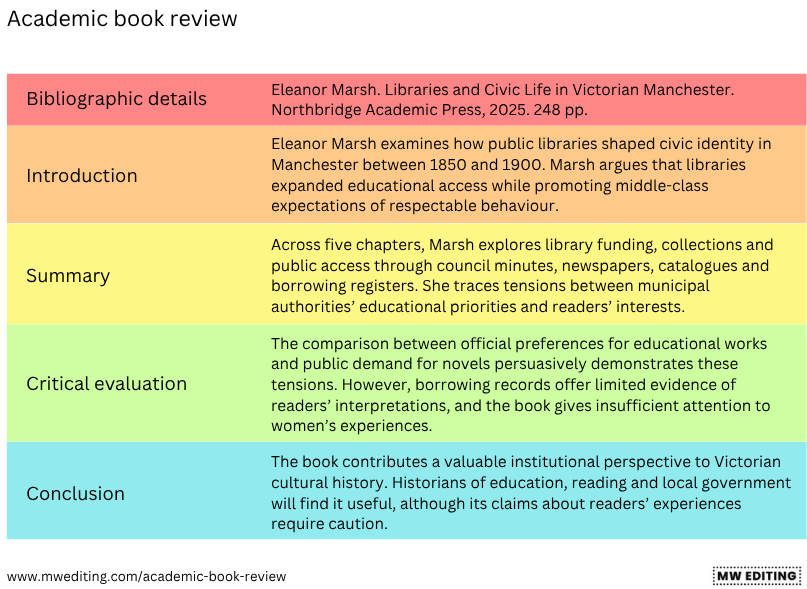
Example of an academic book review
Eleanor Marsh. Libraries and Civic Life in Victorian Manchester. Northbridge Academic Press, 2025. 248 pp.
Eleanor Marsh examines how public libraries shaped civic identity in Manchester between 1850 and 1900. She argues that libraries gave residents access to education but also promoted middle-class expectations about respectable behaviour. The book offers a persuasive account of this tension, although its evidence reveals more about institutional ambitions than readers’ experiences.
Across five chapters, Marsh traces debates about library funding, collection development and public access. She draws on council minutes, newspaper reports, library catalogues and borrowing registers. Her central claim links these sources: municipal authorities treated libraries as instruments of civic improvement, while readers pursued interests that sometimes challenged official priorities.
The book’s strongest contribution lies in its analysis of fiction borrowing. Marsh compares committees’ stated preference for educational works with records that demonstrate sustained demand for novels. For example, Chapter 3 shows how librarians restricted access to popular fiction despite its substantial share of recorded loans. This comparison supports her argument that public libraries became sites of negotiation over legitimate reading.
However, borrowing records cannot establish how readers interpreted books. Marsh occasionally treats a loan as evidence of intellectual engagement without sufficient qualification. Diaries, correspondence or readers’ contributions to local newspapers could have strengthened these claims. Moreover, the limited discussion of women’s experiences leaves questions about how gender shaped access and participation.
The book nevertheless adds a valuable institutional perspective to histories of Victorian reading. Its close attention to municipal decision-making connects cultural provision with local governance. Clear organisation and well-chosen examples also make the argument accessible, although several tables would benefit from fuller explanations of gaps in the records.
Overall, Libraries and Civic Life in Victorian Manchester makes a convincing case for the public library’s importance in urban cultural history. Historians of education, reading and local government will find its analysis useful. Its conclusions about readers’ experiences require greater caution, but its account of institutional priorities provides a strong basis for further research.
What to avoid when writing an academic book review
In sum, an academic book review should avoid excessive summary, unsupported judgements and personal criticism of the author.
Common pitfalls include:
- Excessive description: keep the summary brief and prioritise critical analysis.
- Unsupported praise or criticism: explain each judgement with specific examples from the book.
- Personal attacks: assess the scholarship, evidence and reasoning rather than the author’s writing style or opinions.
- Unfair expectations: evaluate the book against its stated aims and scope before identifying omissions.
- Inaccurate representation: check quotations, page references and paraphrases against the text.
- Lack of scholarly context: explain how the book relates to relevant research.
- Excessive quotation: quote selectively and leave sufficient space for analysis.
- A vague conclusion: give a clear overall assessment of the book’s contribution and audience.
- Disregard for submission guidelines: follow the publication’s requirements for length, structure and references.
- Finally, use a book review format example as a structural guide, but adapt the analysis to the book and the publication.
What to always include in an academic book review
In summary, an academic book review should include the book’s bibliographic details, a brief summary, an evidence-based critical evaluation and an overall assessment.
Include these essential elements:
- Bibliographic details: identify the author or editor, title, publisher and publication year.
- Purpose and scope: explain the book’s aims, subject coverage and intended audience.
- Central argument: summarise its main claims and approach.
- Critical evaluation: assess the argument, evidence, methods and organisation against the book’s stated aims.
- Specific examples: support judgements with examples from the text and page references where appropriate.
- Scholarly contribution: explain how the book develops, challenges or synthesises existing research.
- Concluding assessment: state its overall value and relevance to particular academic readers.
- Finally, adapt this book review format example to the publication’s submission guidelines.
Format example of an academic book review
This academic book review format example provides questions for each section whose answers form the basis of an academic book review.
1. Bibliographic details
- What are the author’s or editor’s name, the full book title, publisher and publication year?
- What additional details does the publication require, e.g. page count, price or ISBN?
2. Introduction
- What subject or research problem does the book address?
- What does the author aim to achieve?
- Who is the intended audience?
- What is the review’s overall assessment of the book?
3. Brief summary
- What is the book’s central argument?
- What topics, periods or geographical areas does it cover?
- How does the author organise the material?
- What sources, theories or methods underpin the analysis?
4. Critical evaluation
- How convincingly does the author develop the argument?
- How effectively do the evidence and methods support the conclusions?
- What are the book’s main strengths, and which examples demonstrate them?
- What limitations, inconsistencies or gaps affect its claims?
- How well do the structure and prose communicate the ideas?
- To what extent does the book fulfil its stated aims?
5. Contribution to scholarship
- How does the book relate to existing research?
- What new evidence, interpretations or approaches does it offer?
- Which debates does it advance or challenge?
- What questions does it leave open for further research?
6. Conclusion
- What is the book’s most significant contribution?
- How do its strengths and limitations shape the overall assessment?
- Which readers or research projects would benefit most from it?
Finally, remember to combine the answers into connected paragraphs and follow the publication’s requirements for length and structure. Once the draft is complete, copyediting or proofreading for short texts can help address language and presentation before submission.
Resources
- University of North Carolina Writing Center: Book reviews explains how to develop an assessment, balance summary with analysis and organise a review.
- Wendy Laura Belcher: How to write an academic book review covers book selection, contact with journal editors, critical reading and common pitfalls.
- LSE: 10 essential tips for academic book reviewers offers practical advice on the purpose and process of scholarly reviewing.
- LSE: How to write a book review: Writing introductions focuses on effective opening paragraphs.
Preparing an academic book review for publication
Professional services such as line editing, copyediting and proofreading can help prepare an academic book review for publication through stronger analysis, clearer prose, consistent presentation and final checks.
Clarity and flow
A line editor refines sentence structure, removes repetition and strengthens transitions between ideas. As a result, readers can follow the reviewer’s argument and distinguish the book author’s claims from the reviewer’s assessment.
Accuracy and consistency
A copyeditor checks grammar, spelling, punctuation and consistency in terminology and references. A copyeditor can also flag discrepancies in bibliographic details or quotations, although verification against the book requires access to the source and an agreed scope.
Publication requirements
A copyeditor applies the publication’s style requirements, such as reference format, capitalisation and treatment of book titles. Meanwhile, a developmental editor can recommend cuts if the review exceeds the word limit. A book review format example offers an initial framework, but the publication’s guidelines determine the final requirements.
Final presentation
A proofreader checks the final text or publication proofs for remaining typos, punctuation errors and layout problems. This final check can catch missing italics, inconsistent headings or errors that arose during typesetting. MW Editing’s service for texts under 10,000 words includes copyediting and proofreading for academic book reviews.
Conclusion
An effective academic book review offers a clear, fair assessment that draws on specific evidence and places the book within existing scholarship. Use a book review format example to organise the discussion, then adapt the structure to the publication’s requirements. Finally, check that the review supports its judgements, represents the book accurately and explains its value to academic readers.
Contact me if you are an academic author looking for editing or indexing services. I am an experienced editor offering a free sample edit and an early bird discount.
If you would like professional help refining your text for clarity, consistency and presentation, you can also use my short-text editing service for a fast, straightforward edit with transparent pricing and a five-day turnaround.